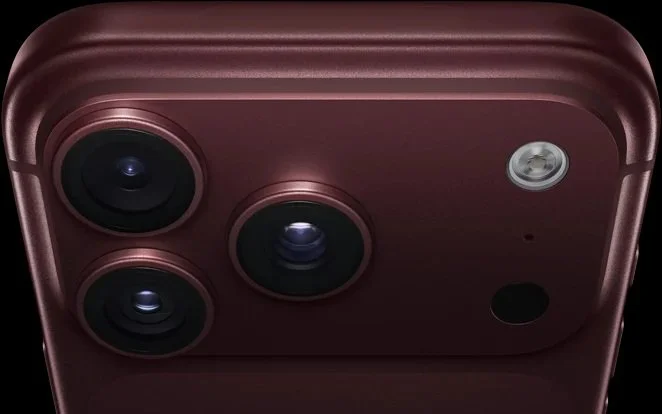
Hardware Breakdown Presents: The iPhone 18 Pro Camera
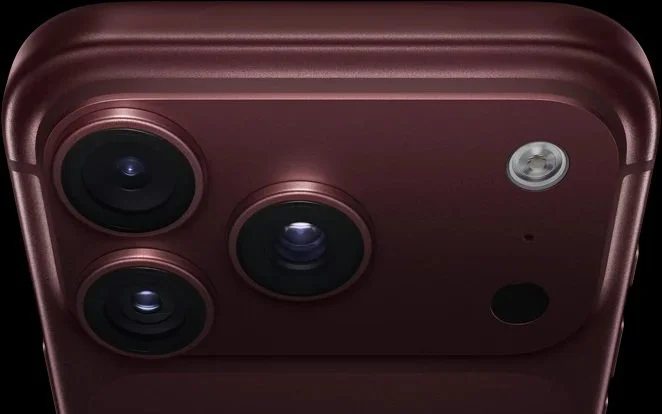
One component in the iPhone 18 Pro has caught my attention: the camera. This visual-capturing component marks Apple's transition from fixed-optic computational workarounds to active electro-mechanical mechanics. Under the hood, Apple has completely overhauled the camera's mechanical stack to tackle sensor-plane exposure balance and depth falloff in hardware. As always, in this monthly installment of Hardware Breakdown, I outline certain components that define the device. In this case, it's the iPhone 18's camera.
The 48MP Fusion Main Camera: Electro-Mechanical Iris
The iPhone 18 Pro main camera's engineering feat is its physical, motorized iris assembly positioned between the hybrid lens group and face sensor. The Iris architecture uses six laser-cut polymer composite aperture blades mounted on a small motorized rotor mechanism.
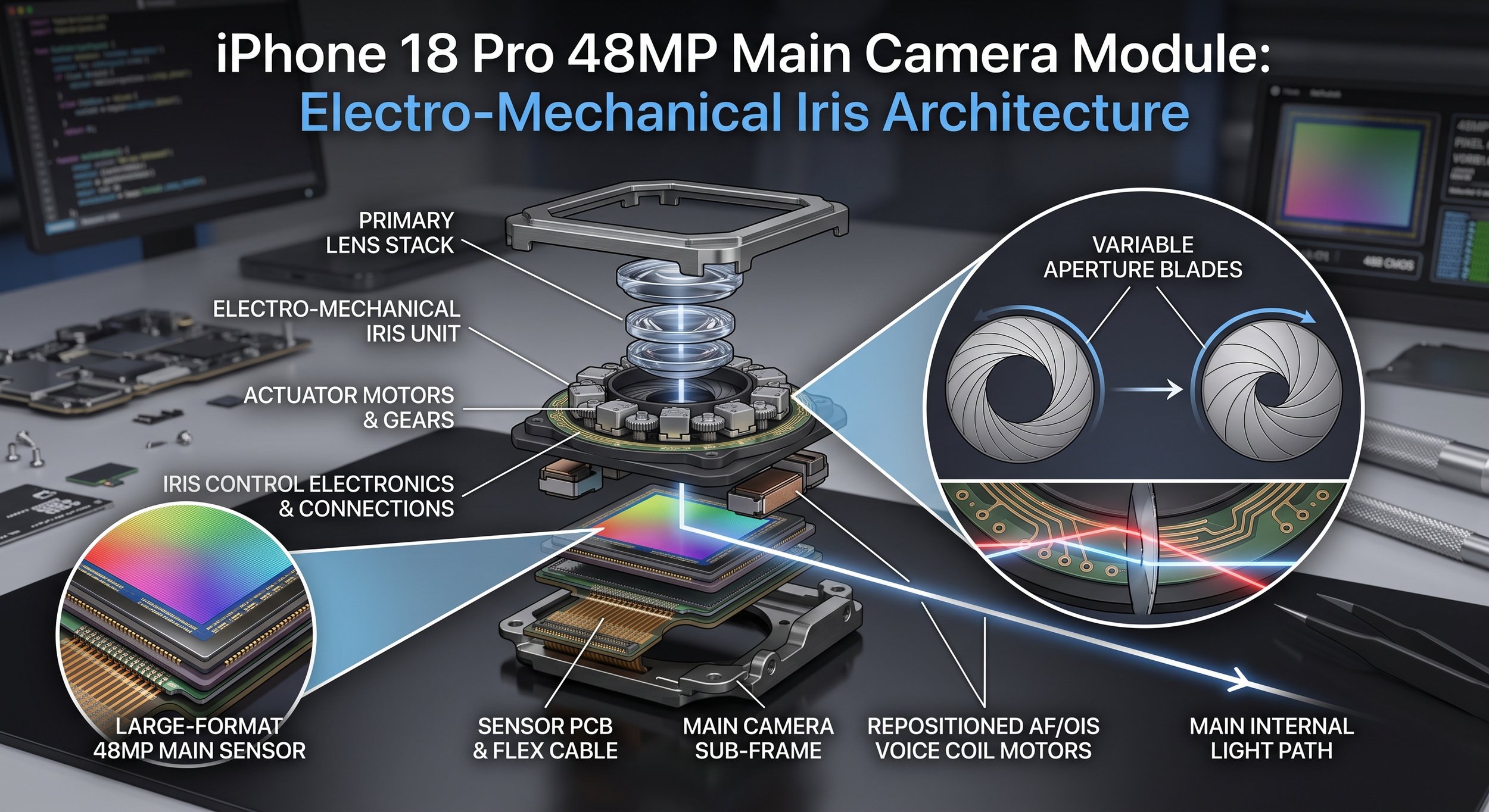
The actuator cycles the blades across four discrete optical stops. Each has a specific responsibility. They are as follows:
f/1.48 is the maximum opening, capturing roughly 45% more light than previous fixed lenses for low-noise, low-light capture and native shallow depth of field.
f/1.8 balances baseline and is used by default for portraits and general framing.
f/2.8 is an intermediate stop for expanding depth across multi-subject foregrounds.
f/4.0 is the smallest aperture; it expands depth of field for high-contrast landscapes and macro edge-to-edge sharpness without diffraction softening.
The camera's sensor shift is backed by a customized 48MP stacked CMOS image sensor measuring 1/1.28-inch, optimized for 1.22-micron pixels. The camera's stabilization relies entirely on second-generation sensor-shift OIS, with a copper voice-coil motor that counteracts handshakes across the X and Y axes independently of the lens barrel.
Further Breaking Down 48MP Folded Tetraprism Telephoto
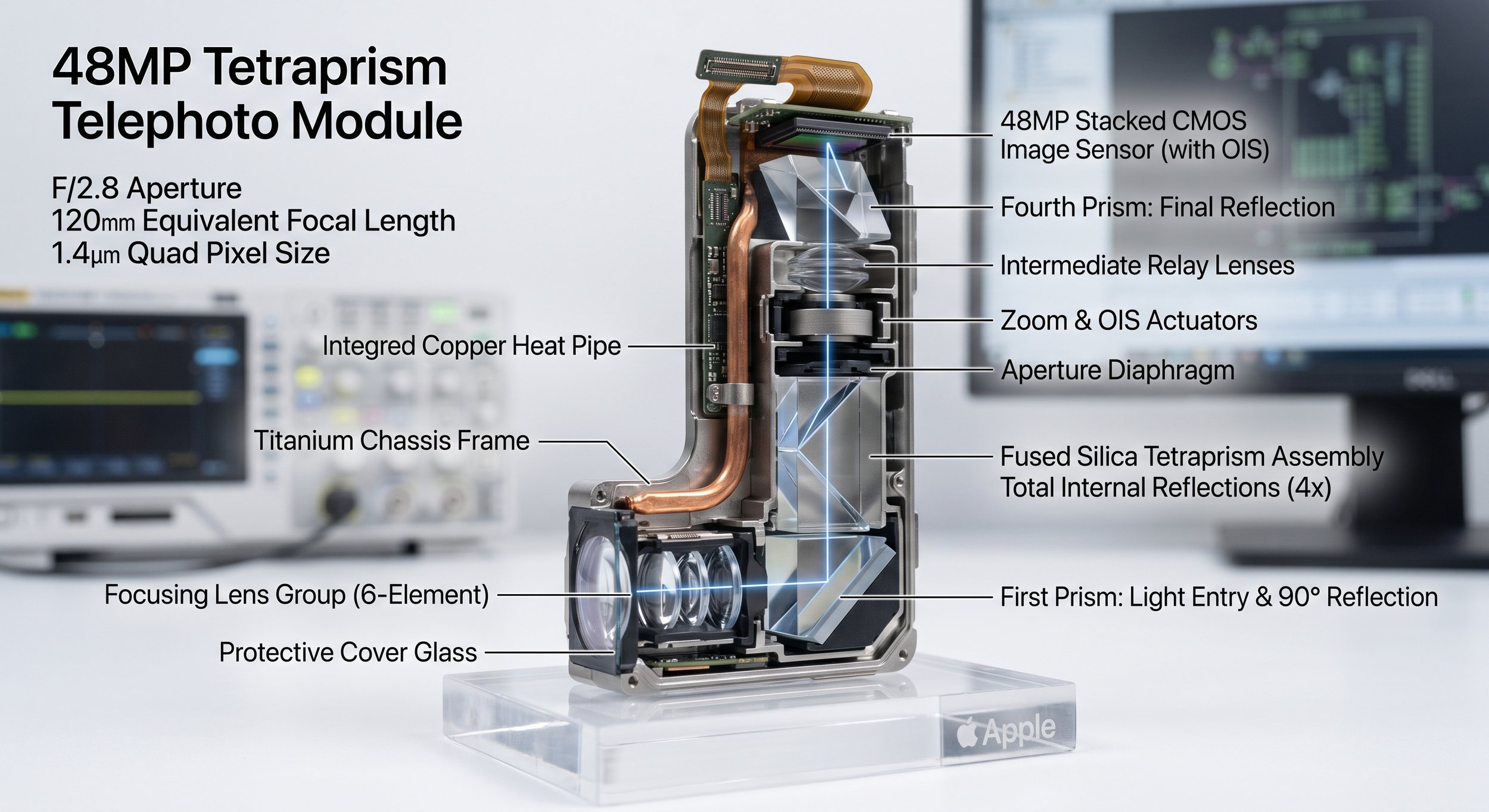
The telephoto system packs long-length optics into an 8.6 mm small-size chassis by folding the path.
The Tetraprism Optical Core is a precision-cast internal glass prism that bounces incoming light four times internally before it hits the sensor plane, extending the path to a 100mm equivalent (4x optical zoom) at an f/2.8 aperture. The sensor crop capabilities come from a high-resolution 48MP sensor, enabling a lossless 12MP center crop at an x8 optical-quality zoom, equivalent to 200mm.
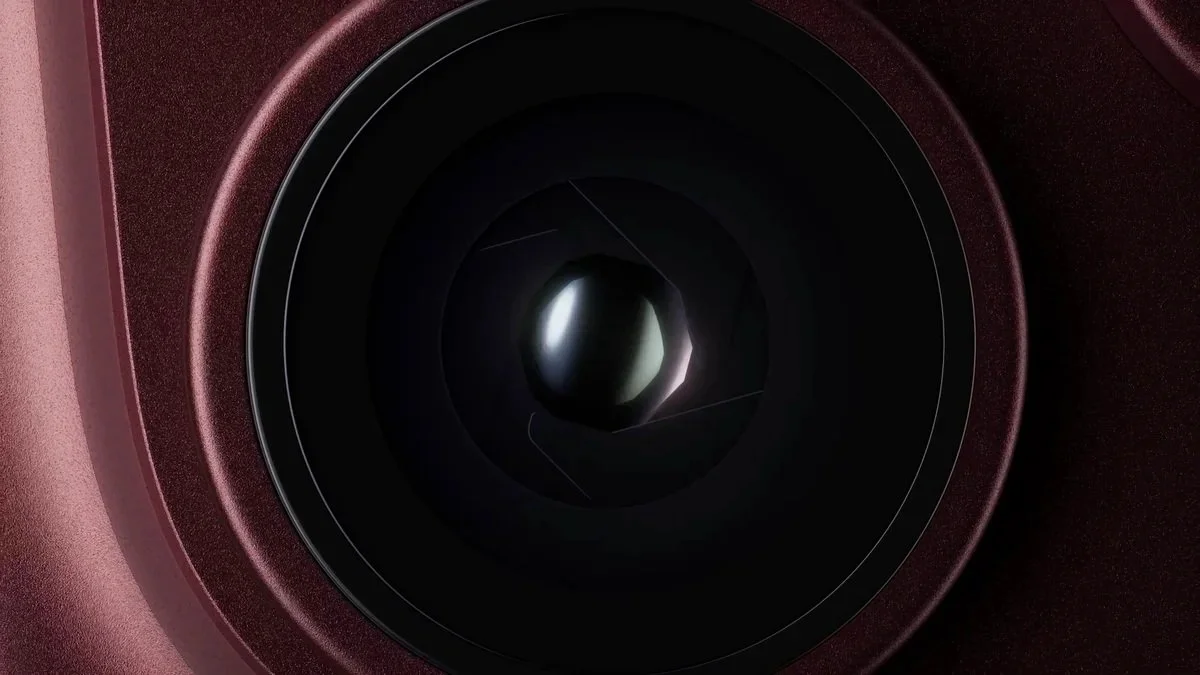
The 3D Sensor-shift and Autofocus Modules stabilize severe focal vibration at 100 mm; the module uses a unified 3D sensor-shift mechanism that drives micro-movements along three traditional axes while modularizing autofocus from a distance.
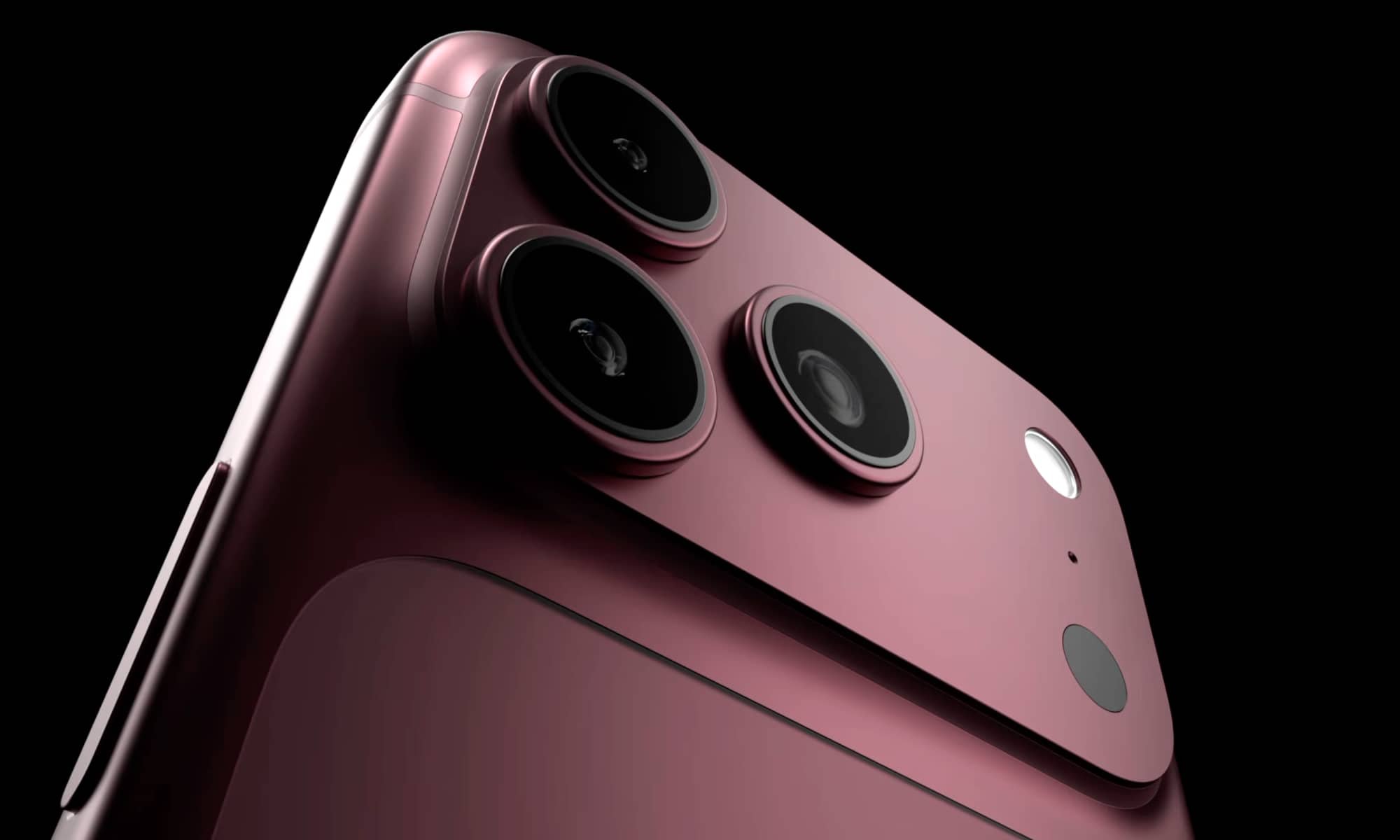
The Thermal Integration and Sensor Suite Explained
Surrounding the iPhone 18 Pro's primary imaging lenses are auxiliary scanning and environmental management components, including a LIDAR scanner that uses a vertical-cavity surface-emitting laser (VCSEL) array that emits invisible infrared pulses, timing photon flight to assemble millimetric 3D depth meshes for instant low-light focus and spatial computing scenes.
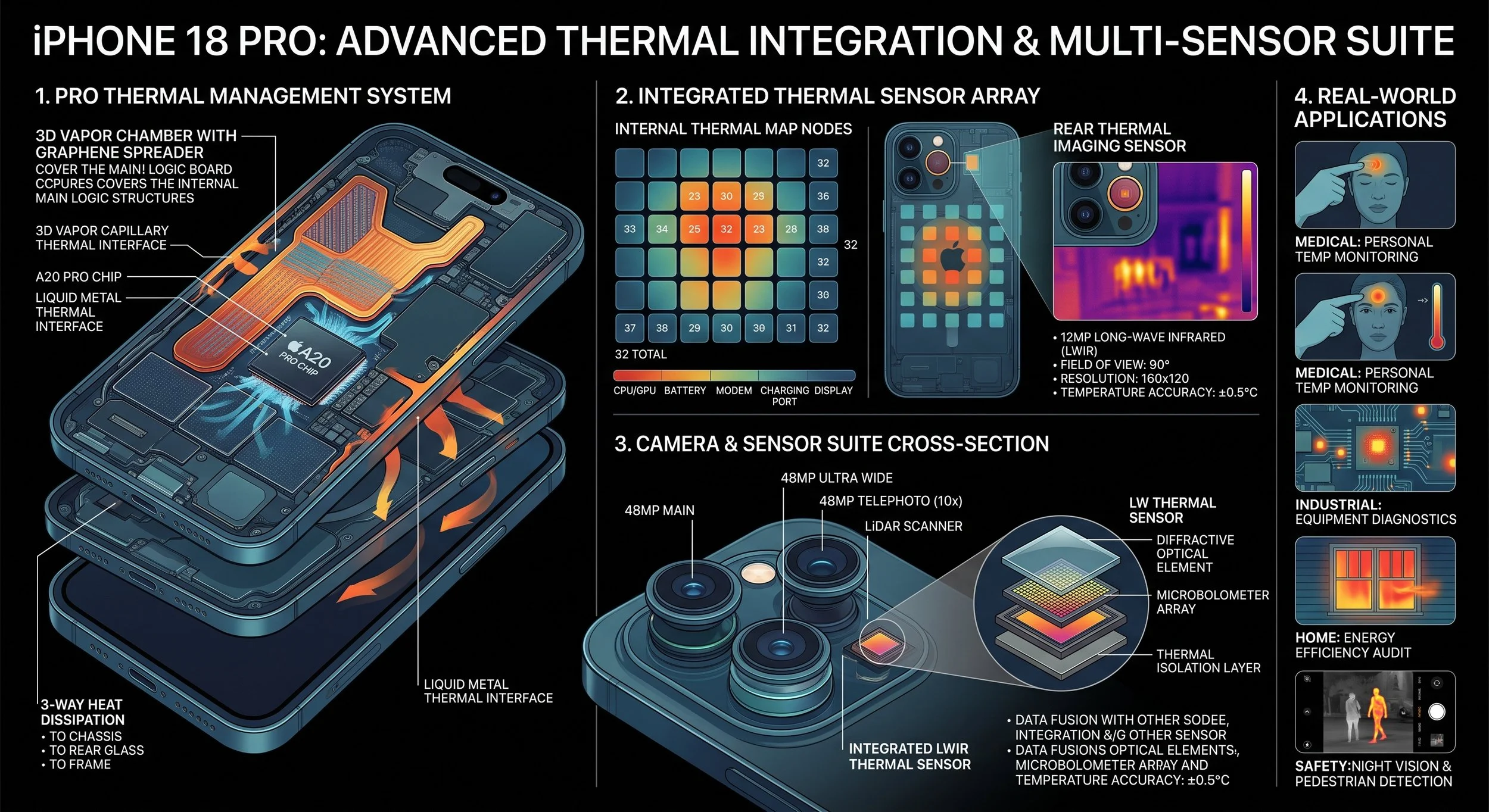
Then there is the Multi-Spectral Flicker Sensor; this analyzes ambient light cycles to instruct the A20 Pro Image Signal Processor (ISP) to adjust rolling-shutter timing and eradicate artificial light banding. Chassis Thermal Coupling lets the entire camera platform connect directly to the smartphone's internal copper vapor chamber, enabling high-throughput tasks such as 4K/120 fps ProRes Log and continuous Spatial Video capture to run without thermal throttling.
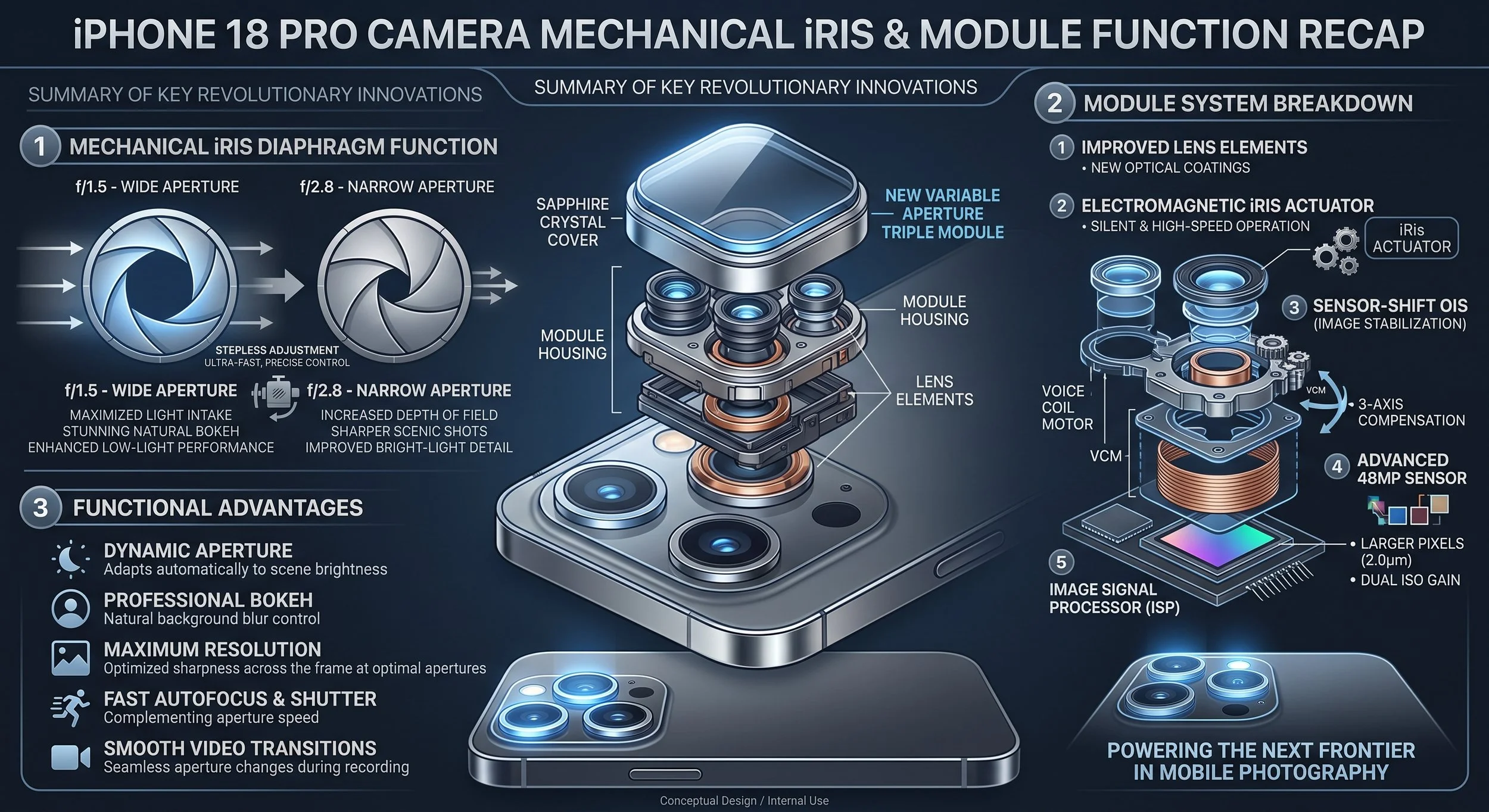
Functional Recap of the iPhone 18 Pro Camera: Mechanical Iris and Module Function
Now that we've broken down the iPhone 18 Pro camera's key components, here’s a checklist to verify how it works. First, the Mechanical Iris Actuation opens the manual camera controls, aimed at a soft light source, toggling between f/1.48 and f/40 as the physical six-blade iris contracts inside the lens.
Second, the sensor-shift damping Engages Action mode or 4K/60 fps video, verifying that the voice-coil magnetic damping smooths out any sudden hand movement.
Finally, the Macro Clearance test brings the ultra-wide module within 2 cm of a detailed surface, ensuring that the autofocus voice coil engages at the minimum object distance without hunting.
Let’s Conclude This Breakdown
In this new installment of “Hardware Breakdown," I revealed the iPhone 18 Pro camera’s pivotal transition from relying on computational photography to micro-mechanical optical engineering. I outlined the camera’s centerpiece: a variable aperture that packs six ultra-thin polymer composite blades into a standard module footprint. All while delivering physical Iris control over exposure and depth of field. This fundamentally changes smartphone camera hardware by introducing moving parts into the optical stack. Simply amazing.
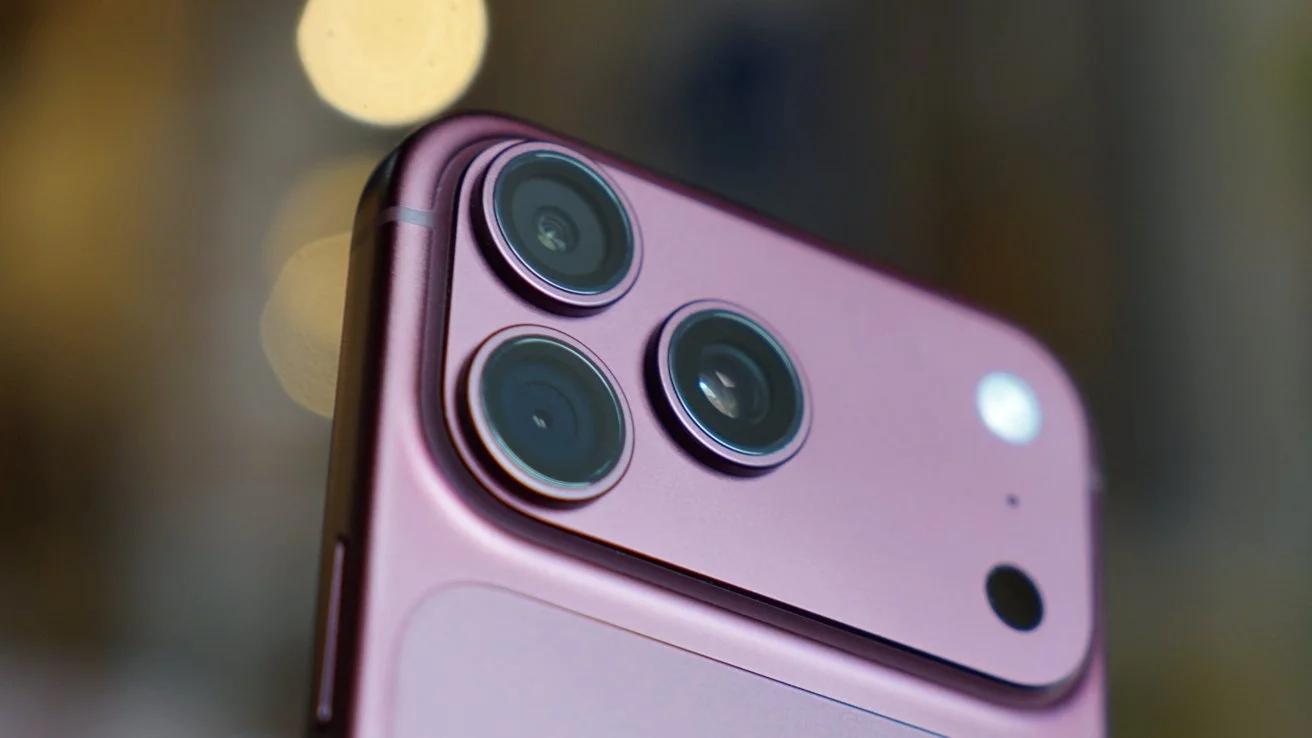
Does this hardware breakdown of the iPhone 18 Pro camera entice you to purchase this device? If so, drop your comments in the box below and let me know what you think of its camera and the entire device overall.